


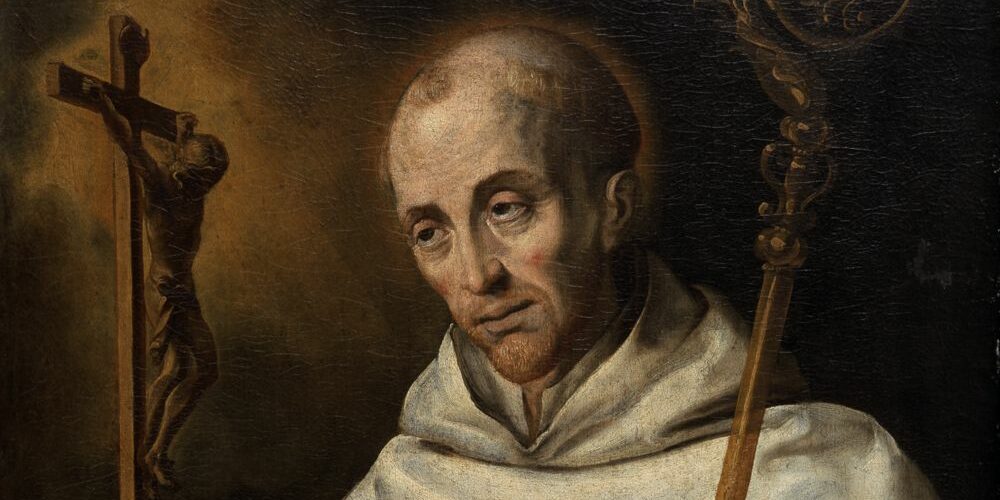
The role of Saint Bernard of Clairvaux in the order of knights
Bernard of Clairvaux, whose real name was Jean de Fontaine, was the great provider and protector of the Order of the Poor Knights of Christ and the Temple of Solomon. He was born in 1090 at Fontaines Castle, near Dijon, the son of Sorrel Tescelin and Aleth, a noble family from Burgundy who had six other children, including only one daughter. Bernard was an important religious and ecclesiastical figure of his time.
He became motherless while studying at the University of Châtillon-sur-Seine. According to sources, after this loss, Bernard fell into depression. During a moment of prayer, at nearly twenty years old, in 1112, he decided to enter religious life in a Benedictine monastery. Almost all of his brothers followed him into the monastery; only the youngest, Nivard, remained to take care of the family lands.
Subsequently, Saint Bernard helped found the first Cistercian houses, an order that had been established 15 years earlier but was only recognized as a separate order from the Benedictines after his entry.
In 1112, two years after Saint Bernard entered the Cistercian abbey, he was designated to found another monastery at Clairvaux, where he was elected abbot. The monastery of Clairvaux became the cradle of great historical changes, as its founder, Saint Bernard, was a great defender of clerical attitudes and ethical and religious behavior. He did not accept behaviors contrary to the Holy Scriptures, cultivating austerity and advocating simplicity.
In 1119, Bernard was summoned by Stephen Harding to participate in the General Chapter of the Cistercians, a key milestone in the formation of the Order of the Temple. The Charter of Charity, written during the chapter, was confirmed by Pope Callixtus II.
According to sources, it was after this event that Bernard began writing his main works, treatises, and homilies. Among his writings, the following stand out: the Treatise on the Love of God, the commentary on the Song of Songs, and especially an apology, written at the request of William of Saint-Thierry. In this apology, he defends the principles observed by the Benedictine monasteries known as the “Whites” (the Cistercians, according to the color of their habit), opposing them to the aspects related to the Benedictine monasteries known as the “Blacks” (the Cluniacs). Peter the Venerable, the abbot of Cluny, responded to him amicably, and despite their ideological confrontations, the two men became friends.
Saint Bernard was a great writer, whose work is still used today by Christians because it is timeless and relevant. According to bibliographical sources, the invocation “O Clement, O Pious, O Sweet Virgin Mary” is attributed to him.
Due to his literary production, he was declared a Doctor of the Church in 1830 by Pope Pius VIII.
Bernard was related to Hugues de Payns and André de Montbard (of whom he was the nephew), founders of the Order of the Temple. After founding the new order with the approval of the Patriarch of Jerusalem, Payns sought official recognition from the Catholic Church. To do this, he traveled to Rome in 1127, carrying a letter from the Regent of Jerusalem, Baldwin II, to Abbot Bernard: “I ask you to support the master of the order”. Bernard, seeing that the new order aligned with his ideas of sacralizing the militia as a means of defending the faith, religious morality, and the most vulnerable (the elderly, children, and widows), welcomed the request with enthusiasm and became the main defender of the Templars.
Thanks to his influence, Bernard succeeded in having the master of the order received by Pope Honorius II and in having a council convened in 1128 in Troyes, presided over by the pope’s representative, Cardinal Mateo de Albano.
Summoned by Pope Honorius II, Bernard participated in this council, where, despite strong opposition from a part of the clergy dissatisfied with the monk’s presence, he was appointed secretary of the Council. During the Council of Troyes, Saint Bernard presented the principles and first services of the new Order of the Temple. Although there were some questions, he was able to answer them with wisdom and prudence. After several weeks of interrogations, the order was approved, and it was decided that Bernard of Clairvaux would provide an original rule for the Knights of the Order of the Temple, as they already had a rule, that of Saint Augustine and Saint Benedict, but Saint Bernard believed that his protégés should follow his own rule.
The new monastic rule, which presented the principles and services of the Order of the Temple after its approval, quickly became the ideal of nobility used in the Christian world. According to this rule, knights had to observe the vows of poverty, chastity, and obedience, and dedicate themselves to the defense and protection of holy places, even at the cost of their lives if necessary. This new rule was limited to the high ranks of the order; others only needed to know its color, to preserve it if it fell into the wrong hands.
Saint Bernard supported the master Hugues de Payns in the search for new members, drafted the statutes of the order, and, as already mentioned, succeeded in having the pope convene the Council of Troyes for its approval and recognition. With a clear influence on his time, Bernard became a respected figure in Christianity and began to intervene in public affairs, more openly defending the rights of the Church against secular princes, advising popes and kings. For some, it was Bernard who chose the popes. His influence was so great that after the death of Pope Honorius II in 1130, during the schism of Anacletus II, his voice was heard and it ended with the acceptance of Innocent II.
Despite all this power, Saint Bernard cultivated an austere and simple lifestyle, which was attested by Pope Innocent II during his visit to the monastery in 1131. The pope stayed there until the following year, when he returned to Italy accompanied by Bernard, who traveled to participate in the Council of Pisa. Saint Bernard, before returning to Clairvaux, passed through Milan, developing his religious mission.
In 1145, Pope Eugene III, a Cistercian monk from Clairvaux, asked Saint Bernard to encourage a new crusade, as the Christian kingdom of Edessa was in danger. Despite the failure of this crusade, Saint Bernard became even more influential, mainly through the consolidation of the Knights Templar and the growth of the Cistercian Order. He ensured that the Knights Templar promised to protect the Cistercians under oath.
For many scholars, the courage and resilience of the Templars resulted from the influence of Saint Bernard, as the saint used his charisma not only to gain more supporters for monastic life but also to instill in the Templar warrior fearlessness in the face of death. Saint Bernard presented death not as a defeat, but as a victory, because dying in battle made the Christian a martyr. Enemies knew that facing a Templar meant confronting a different kind of warrior: disciplined, trained, focused, fearless, and without fear of death. Saint Bernard gave the Templars courage, discipline, organization, privileges, and respect.
Saint Bernard said: “A knight of the Order of the Temple is truly a fearless and secure knight on all sides, for his soul is protected by the armor of faith, just as his body is protected by the armor of steel. He is thus doubly armed and has no need to fear either demons or men.”
He obtained for the Order of the Temple great privileges, which neither kings nor other religious orders had, thanks to his enormous prestige and influence, including the privilege of not paying tributes and obeying only the pope. In addition to all his sermons, he was known as the great organizer and propagandist of the most famous military order in the West, the Order of the Knights Templar.
The defender of the Knights of the Order of the Temple founded 72 monasteries throughout Europe, including 35 in France, 14 in Spain, 10 in England and Ireland, 6 in Flanders (northern region of Belgium), 4 in Italy, 4 in Denmark, 2 in Sweden, and 1 in Hungary. Many others affiliated with the Knights of the Order of the Temple.
These monasteries welcomed more than 700 monks, and many candidates were refused due to lack of space in the existing monasteries. He died on August 20, 1153 at the abbey of Clairvaux, at the age of 63, after living forty years in the monastery. He was canonized by Alexander III in 1174. He left behind his legacy and the monastic rule of the Order of the Temple, showing his important role for the Temple. For his life story, he is celebrated on August 20.
As an ecclesiastical figure, Saint Bernard was never a Templar, just as Richard the Lionheart or Saint Louis and many others were not monk-soldiers, but only crusaders, while respecting the rule of Saint Benedict and the great Cistercian principles of Christians as dictated by Saint Bernard.
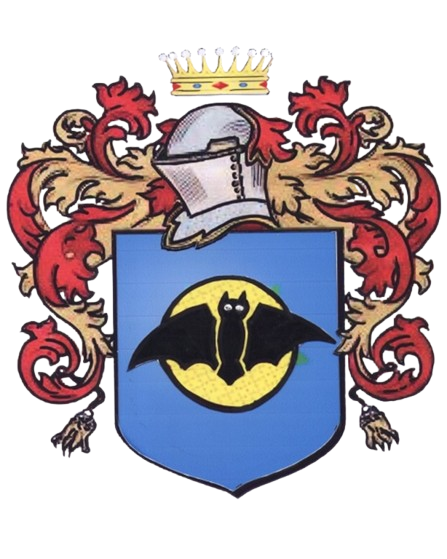
His Eminence Alain Ménard
Eques Nyctalus
Grand Prior General
Knight Grand Cross
Oblate of the Cistercian Order at Latiano Monastery